Karl Eicher was stressed. Karl, owner and brewer at Haggard Barrel Brewing Co. in St. Louis Park, Minnesota, and his dad, Gordy Eicher, had diligently worked to get things going since well before I’d arrived at 6:30 a.m. We were making a lager with Kernza, a highly sustainable grain, that would be presented at the Minnesota State Fair.
Now, a few hours into the process, as we began pumping the fresh wort into the kettle, there was a hiccup. A 2-1/2-inch gasket was missing. This small disc of black rubber and its accompanying metal clamp were mandatory.
My mission had been simple: shadow a professional brewer using industrial equipment, do some backbreaking labor and gain a better appreciation of the process. Haggard Barrel made sense, because it was new and smaller scale but still churning out tasty, award-winning brews.
The errant gasket changed that. But as a result, I saw a different side of what makes brewing so difficult — and what makes the craft beer community so unique.
1. Cleaning is (nearly) everything
The missing piece would connect a hose from the kettle to the fermentation tank once the wort boiled long enough and received all the hop additions. Before that, it would help with cleaning the fermentor, which is no small step.
How much of the brewing process is cleaning? “About 90%,” Karl said.
He’d experienced this during five years at Lift Bridge Brewing Co. and another two at BlackStack Brewing after opening the former 12welve Eyes Brewing Co. Some large operations spend days only cleaning and sanitizing.
“If you’re too focused on making beer, you’ll lose sight of the support stuff that has to happen around it,” he said.
2. Brewing offers a sensory experience


The mash, the process of cooking malt in hot water in an open vessel called a mash tun, makes everything hot. Brewers heat up water to 180 degrees, then lower the temp to about 160, based on the recipe. Karl regretted he didn’t tell me to bring a second shirt to wear after sweating through the mash.
“It’s so humid in here, my phone thinks there’s moisture in the charging port,” he said at one point.
When the water is just right, it’s pumped into the mash tun, along with minerals to mimic water profiles from the beer’s homeland.
Next, adding the malt is the easy part. You slice the bag with a utility knife, then pour. Stirring the grain with the mash paddle is like paddling a canoe through oatmeal.
There’s a whole catalog of sounds — droning, trickling, gurgling. Visually inspecting the beer’s color and clarity during the process is important, too. And the process wouldn’t be complete without taste.
At 8 a.m., we professionally analyzed a sample of still-fermenting extra pale ale. That is, we tasted the brew, which Karl poured straight from a valve on the five-barrel tank.

3. It’s a team sport
Since it was a Saturday morning, suppliers were closed, and fellow brewers were a little slow to respond to Karl’s social media post and texts asking for a favor.
Haggard Barrel’s other founders, Zack Johnson and Gabe Wrenholt, were also on the case. But it didn’t help that 2-1/2 is an oddball size, so only a few places would have the gasket, much less one to spare.
I wanted to be useful, more so than doing the most basic tasks and posing for a photo op. And I had a pretty good idea of someone who could help, a contractor who specializes in breweries named James Lee.
Gordy and I set off to track down the piece, starting at Venn Brewing Co. taproom in south Minneapolis. Then after finding all of the pieces in use, we drove to Venn’s new production facility in St. Paul. Gordy and I gaped at the shining 30-barrel system, the numerous towering fermentors and the walk-in cooler the size of my house. In the corner, multiple electric hot water heaters provided on-demand 180-degree water.
I explained to the other James that Haggard Barrel is a very different operation.
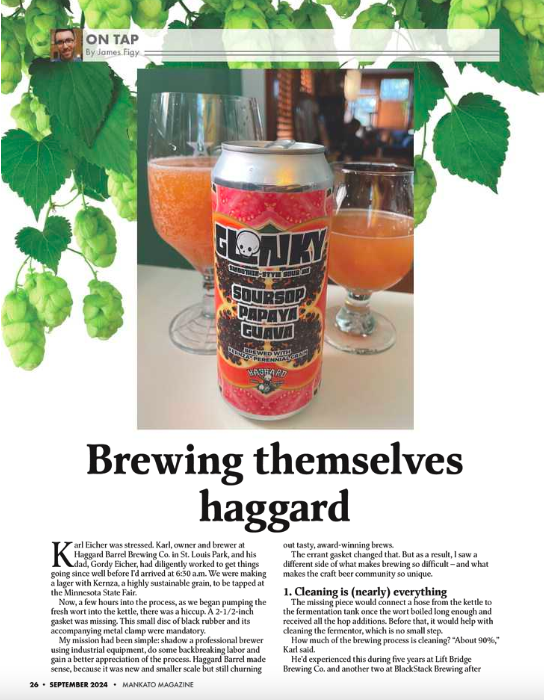
“They’re bootstrapping it, right? Well, they’re doing something right if they’re already winning U.S. Open Beer Championships,” he said, referring to the brewery claiming gold for its smoothie-style ale, Glonky, which also uses Kernza.


Back at Haggard Barrel, Karl was relieved to have not one but two of the gaskets after his business partner had come through as well. Gordy recounted how impressive the Venn operation was, and Karl listened patiently as he continued to work on the beer that would become Lager Is Ag.
For him, that was his previous experience, brewing massive batches without much say in the running of the brewery. Haggard Barrel was a purposeful change of pace, even if, for the time being, it required him to work a day job and brew during off hours.
Things change when you get into a bigger production brewery, Karl said. “You lose some of that magic.”
James Figy is a writer and beer enthusiast based in St. Paul. In Mankato, he earned an MFA in creative writing from Minnesota State University and a World Beer Cruise captain’s jacket from Pub 500. Instagram: @JamesBeered
This article originally appeared in the September 2024 issue of Mankato Magazine.

 James Figy